
Italian: The modern classical language
A modern language for a classical education

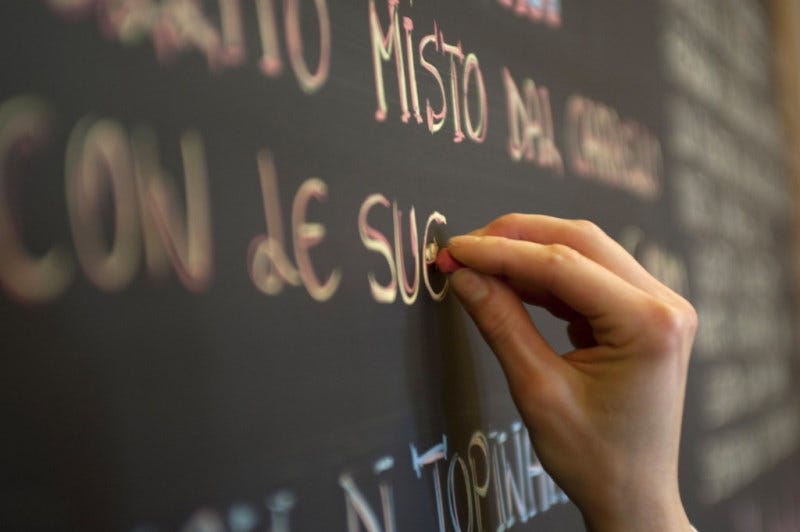
Views on the role of classical languages in the Classical Education curriculum vary as much as definitions of Classical Education itself. For many, Latin and/or Ancient Greek are foundational, the keys to unlocking Western civilisation’s intellectual, literary, and cultural heritage. For others, classical languages are a “nice to have” optional extra, while some see more practical value in a modern language.
I have for some time believed that while there are very good reasons to include classical languages in the Classical Education curriculum, if any modern language also deserves a place in that curriculum it is probably Italian. Its heritage, grammar and vocabulary obviously derive directly from Latin; but Italian also played a unique role in the development of Western civilisation throughout the Renaissance and the centuries that followed, through the works of celebrated authors including Dante Alighieri, Giovanni Boccaccio, Marco Polo, Caterina di Siena, Tommaso Campanella, Niccolò Machiavelli, Galileo Galilei, Giordano Bruno, Giambattista Vico and others (many of whom also wrote in Latin to reach wider European audiences).
So I was intrigued to find essentially this same case made for the study of Italian as a “modern classical language” by Giuseppe Prezzolini in a 1939 issue of The Modern Language Journal (Prezzolini 1939). Prezzolini was an Italian literary critic, journalist, editor and writer, born in Perugia in 1882 and died in Lugano in 1982. In 1903 he co-founded the literary journal Leonardo, and in 1908 founded La Voce, an influential cultural and literary journal. He moved to the United States in 1929 and taught at Columbia University, eventually becoming an U.S. citizen. He was the author of many books of philosophy, history and literary criticism in both Italian and English.
Prezzolini begins with the assertion that in Classical Education languages are studied for their intrinsic value and not their utilitarian value:
“Education is nothing if not disinterested, and the classical languages had the great advantage of handling things devoid of practical value, things that could not be commercialized and exchanged for the necessities of life. They were useful only in one respect: in rendering life loftier and in instilling the love of intellectual research.”
While he believes in the possibility of a classical education through the medium of a modern language, this is on condition that the study of that language has the same aims as the study of the ancient languages. He has no time for “those who praise the knowledge of a foreign language on the ground that it enables one to correspond with a foreign friend, or to bicker over hotel bills in the country one happens to be visiting. These and other such advantages offered by the modern languages are, of course, valuable, but they are technical, practical, and not educational.” Those who teach modern languages for their utilitarian value “tend to produce machines and not men; they produce purchasing agents, interpreters, diplomats, grammarians, lexicographers, and – sadly enough – teachers technically equipped to teach but, alas! devoid of a soul.” In other words, regardless of whether the language that is being taught is ancient or modern, the aim should be the same, namely to foster humanity and to mold character and minds.
Next, Prezzolini addresses the question of why Italian is the pre-eminent candidate for a “modern classical language”. Any candidate must be a language that “paved the way for our modern civilization”, and of all the possible candidates, Italian was the earliest and most influential. He quotes from a lecture at Cambridge University by Professor Raffaello Piccoli at length:
“It was according to the natural order of things that Italy should be the first among the nations of Europe to produce a modern, as distinct from and opposed to a mediaeval, literature, and that it should fall to her lot to lay the foundations of the modern world. The Italian Renaissance does not consist in the rediscovery of some manuscripts and of some statues in the fifteenth century: it is coeval with the spiritual awakening of the Italian nation in the thirteenth century, and that rediscovery was but the consequence of the spontaneous birth of a new spirit. Dante remains at the confluence of the mediaeval and of the modern world, expressing in the universality of his poetry a vision too ample and too deep to be confined within either national or temporal determinations. But Petrarch and Boccaccio, and the rest of the Italian poets and artists and scholars and thinkers between their time and the end of the sixteenth century, work for the creation of the complex image of the good life which is at the same time the integration of the classical ideal and the basis of modern civilization. It is only in the sixteenth century, and under the guidance of Italy, that England and France and Spain emerge from the Middle Ages; Germany alone, though she had followed more closely perhaps than any other European nation on the steps of Italian Humanism, had to wait for a true Renaissance, delayed by the contrasting spirit of her religious Reformation, until the middle of the eighteenth century.”
Prezzolini suggests that literary culture of the Italian Renaissance was as close in spirit to that of the classical world as it was possible to be:
Imagine for a moment that at the end of the sixteenth century all trace of the Graeco-Roman world had been lost – the texts of its classics as well as its architecture, statues, paintings, fables, customs and beliefs. What modern literature and what country would give us today the truest idea of the classical world, would bring us into the closest union with it, would enable us to feel the utmost power of its pervasive spirit? I believe there can be no doubt about the answer. The virtue of the classics, their power, taste, tendencies, beliefs, sentiments, and that indefinable atmosphere that constitutes classical culture which survive in Italian literature, exist nowhere else.
Prezzolini goes on to characterise the Italian Renaissance as a Janus-headed phenomenon, inspired by “a restoration of the art and thought of antiquity” but simultaneously representing the beginning of “a new epoch, under the guise of a revival of ancient times; an epoch which actually laid the foundation of modern times”:
“Our world, the world we live in today, is essentially a creation of the Italian people, by which I do not mean their thinkers, artists, and writers alone. The Italian people began the Renaissance at the very moment they began to live an independent economic and political life; that is, between the early part of the eleventh and the end of the twelfth centuries when they broke the chains of feudalism, became concentrated in cities, created with their communes a new state, the city-state, developed capitalistic economy, laughed knighthood out of Italy, and absorbed the spiritual content of the medieval church and its civilizing function, which was taken over by the Laity. The Renaissance had its origin during this period and not a century or two afterwards, when the effort to imitate the classics became more deliberate and evident. Rome had never ceased to be present in the mind of Italian cities, families, thinkers, and poets. Roman law was revived in Bologna, a school of medicine rose in Salerno, and the modern state appeared in Sicily not only long before anything like it took place in other countries, but also long before the beginning of the Renaissance as officially recognized by textbooks.”
Prezzolini’s enthusiastic advocacy for Italian language and culture is understandable, and even if he overstates the case somewhat, it is difficult to dismiss the general thrust of his argument: after Latin and Ancient Greek, few languages are more suitable language to include in the Classical Education curriculum than Italian.
References
Prezzolini, Giuseppe (1939). Italian: The Modern Classical Language. The Modern Language Journal, 23(5), 371–378. https://doi.org/10.2307/316837
Geat words!